
News Truck TarpsWaterproof TarpsHeavy Duty TarpsTarp Buying GuideTarp ProblemsOutdoor Use
2026年4月30日
Why Your Truck Tarp Always "Retires" Early: The 80% Rule and How to Kill the "Kite Effect"
Picture this: You are cruising down the highway at 70 mph. The radio is playing, you’re making good time, and then you hear it. Thwap... thwap... thwap... RIIIIIP. You check your rearview mirror and
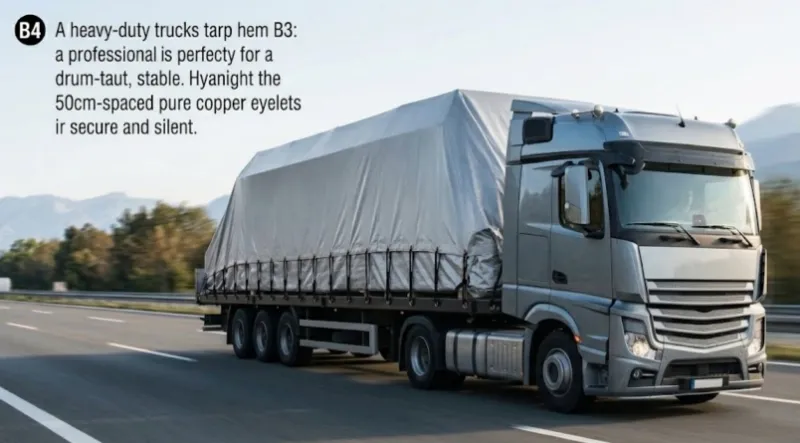
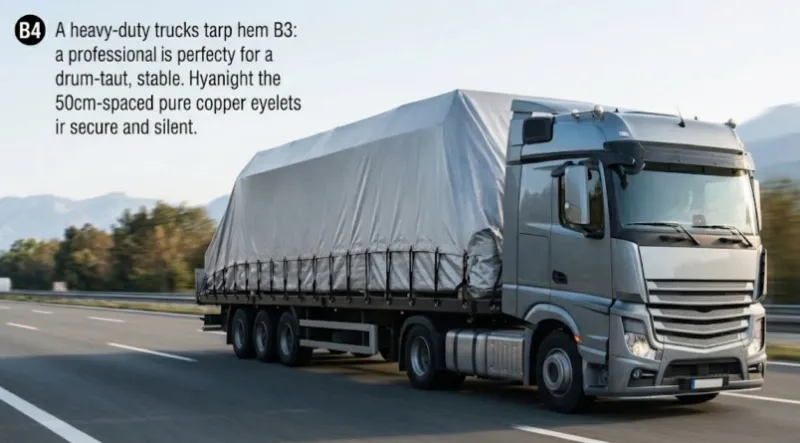
Picture this: You are cruising down the highway at 70 mph. The radio is playing, you’re making good time, and then you hear it.
Thwap... thwap... thwap... RIIIIIP.
You check your rearview mirror and see your brand-new cover violently flapping in the wind like a giant, frantic flag. You pull over at the next exit, walk to the back of your rig, and let out a heavy sigh. The fabric is torn to shreds, the metal rings have popped out like loose teeth, and your cargo is completely exposed to the elements.
If you haul freight, you know exactly what I’m talking about. Dealing with a ruined
tarpaulin for truck mid-transit is the absolute worst. It causes delays, risks your cargo, and burns a hole in your wallet.But here is the million-dollar question: Why do so many truck tarps die after just a few weeks on the road? Most drivers blame the fabric. They think, "I just need a thicker plastic sheet." But they are completely wrong. 80% of buyers fall into this exact trap. The truth is, your tarp isn't dying because the fabric is weak. It’s dying because you are ignoring the most crucial detail: the tie-down hardware.
Let's talk about the dreaded "Kite Effect," the anatomy of proper
tarp eyelets, and how to strap your load down so tightly it feels like the tarp is literally sewn onto your truck.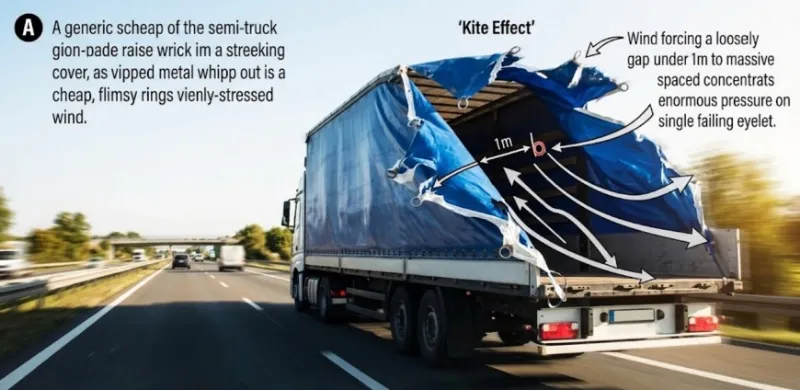
The 80% Trap: Stop Obsessing Over Just the Fabric
When most people buy a
tarpaulin for truck, they only look at one number: the GSM (Grams per Square Meter). They see "180gsm" or "Heavy Duty" on the label and assume they are buying a bulletproof vest for their cargo.Yes, the thickness and the weaving density of the PE (Polyethylene) matter. But a chain is only as strong as its weakest link. If you take a military-grade fabric and punch cheap, flimsy holes in it, what do you think is going to happen when a 60 mph gust of wind hits it?
The weakest links on any tarp are the anchor points. When a cheap tarp fails, the fabric rarely rips down the middle out of nowhere. It almost always starts at the eyelets. The wind pulls the bungee cord, the bungee cord pulls the metal ring, the cheap ring rips through the thin plastic edge, and boom—you have a tear. Once that initial tear happens, the highway wind catches it and unzips your tarp in seconds.
What is the "Kite Effect"? (And Why It's Destroying Your Gear)
Aerodynamics can be your best friend or your worst enemy.
When you buy a standard, cheap tarp from a big-box hardware store, the eyelets (grommets) are usually spaced about 1 meter (over 3 feet) apart.
When you tie that down over an uneven load of machinery, lumber, or pallets, that 1-meter gap leaves a lot of slack in the fabric. As you accelerate down the highway, wind forces its way under that slack. Suddenly, your flat cover turns into a parachute. This is what truckers call the "Kite Effect."
The wind pushes up violently from underneath, while your bungee cords pull down violently from the sides. All of that massive kinetic energy is concentrated directly onto a few cheap, badly installed metal rings. No plastic in the world can survive that kind of focused, aggressive tug-of-war. The eyelets rip out, the wind gets completely underneath, and your tarp is officially "retired."
The Ultimate Fix: How to Make Your Tarp Feel "Sewn" to the Truck
So, how do we defeat the Kite Effect? We don't just give you a thicker fabric; we re-engineer the entire edge of the tarp. Here is the blueprint for a
tarpaulin for truck that actually survives the highway:1. The 50cm Golden Rule
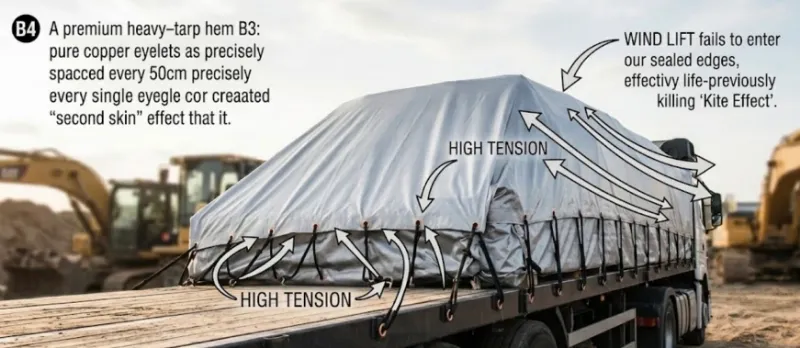
We throw the 1-meter industry standard out the window. On our heavy-duty truck tarps, we punch high-quality
tarp eyelets every 50 centimeters (about 20 inches).Why does this matter? Because halving the distance between the tie-down points cuts the fabric slack by more than half. When you strap down an eyelet every 20 inches, you completely choke off the wind's entry points. The tarp hugs your cargo like a second skin. There is no parachute. There is no Kite Effect. Even in a severe crosswind, the cover feels like it is physically stitched to your truck bed.
2. Pure Copper & Rust-Proof Metal (No More "Loose Teeth")
Have you ever noticed brown rust stains bleeding out from the grommets of your old tarps? Cheap manufacturers use low-grade iron rings to save pennies. After one rainstorm, they rust. Rust creates friction, and friction acts like a tiny saw blade, cutting into the plastic fabric every time the tarp moves.
We use heavy-duty, rust-proof metal—often pure copper or specialized anti-corrosion alloys. They don't rust, they don't degrade, and they are pressed into the fabric with industrial hydraulic machines so they won't pop out when the pressure is on.
3. The Hidden "Backbone" Inside the Hem
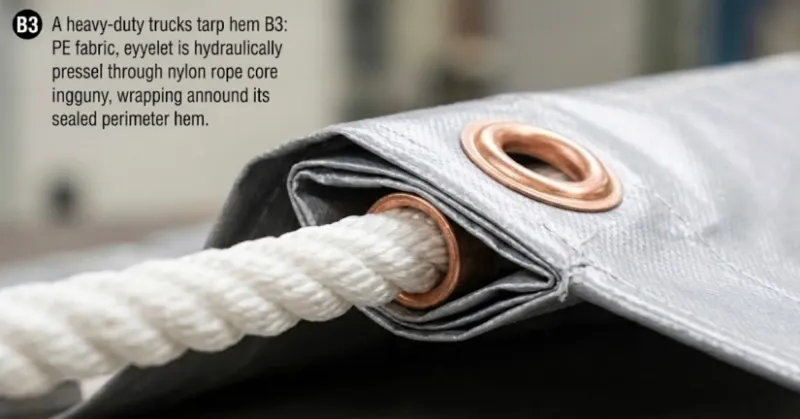
Even the best
tarp eyelets will fail if they are punched into a single, raw layer of plastic.Take a close look at the edge of our truck tarps. It’s not just folded over. We heat-weld the hem and insert a thick, rugged nylon rope completely inside the perimeter. When we punch the metal eyelet, it bites through the folded layers of heavy-duty PE fabric and wraps around that internal rope.
When your bungee cord pulls on the eyelet, the tension isn't just pulling on the plastic—it is distributed along the entire length of the internal nylon rope. It’s like giving your tarp a reinforced spine.
4. The Black Triangle Armor
The four corners of a truck tarp take the most abuse. They are the primary anchor points that get dragged, stretched, and strapped the tightest. That’s why we reinforce all four corners with thick, black engineering-grade plastic triangles. It adds a final layer of unbreakable armor where you need it most.
Stop Paying the "Cheap Tarp" Tax
Let's be real: buying cheap tarps is a terrible business strategy.
If you are spending $30 on a flimsy cover, having it shred on the highway two weeks later, and then buying another one, you aren't saving money. You are paying a recurring "cheap tarp tax," not to mention the risk you are taking with your valuable freight.
You need a
tarpaulin for truck designed by people who actually understand the physics of the road. You need a cover that respects the power of the wind and fights back with tightly spaced, indestructible tarp eyelets.Don't take my word for it. Let me show you. Go out to your driveway right now and look at the eyelets on your current truck cover. Are they rusting? Are they spaced a meter apart? Is the plastic around them starting to stretch and turn white? If so, that tarp is a ticking time bomb.
Want to see exactly how much pulling force our 50cm-spaced eyelets can handle without tearing? Send me a message on WhatsApp. I will personally send you a raw, unedited video of our factory "torture test" where we try (and fail) to rip these eyelets out with a forklift.
Stop letting the wind dictate your schedule. Upgrade your gear, kill the kite effect, and get back to driving with peace of mind.