
News Dumpster Container LinerWaterproof Tarps
2026年4月7日
When "Waterproof" Isn't Enough: The Invisible Leak in Your Waste Logistics
When "Waterproof" Isn't Enough: The Invisible Leak in Your Waste Logistics
We recently took a call from a frustrated fleet manager in the environmental services sector. He was certain his steel roll-off containers were compromised. "Every time we transport wet waste or sludge, we’re seeing trails on the asphalt," he told us. "I’m looking at thousands in potential environmental fines because my containers are leaking."
He thought he had a container problem. He thought he had a tailgate seal problem.
He was wrong. He had a dumpster container liner problem.
We see this "invisible failure" all the time. On a spreadsheet, his previous liners looked perfect—the right microns, the right material, the lowest price. But in the real world, "on paper" doesn't hold water.
The Anatomy of a "Ghost Leak"
When you are hauling 20 tons of saturated waste, the hydraulic pressure at the bottom of that dumpster is immense. Most liners fail not because the plastic is thin, but because the engineering is shallow.
After inspecting the client's failed liners, we found three critical flaws that "cheap" manufacturers overlook:
1. The "Stress-Point" Seam
Standard liners are heat-sealed in a way that creates a brittle "path of least resistance." Under the weight of heavy sludge, these seams micro-fracture. You won't see a giant tear; you’ll see a slow, steady drip that looks like a container leak.
2. Molecular Inconsistency
In low-cost manufacturing, "100 microns" is an average, not a guarantee. We found "thin spots" in the competitor's liners where the plastic stretched to the breaking point before the load even left the job site.
3. Structural Rigidity vs. Flexibility
A liner that is too stiff will crack. A liner that is too stretchy will puncture. You need the "Goldilocks" zone of high-tenacity polyethylene that moves with the load but refuses to give way.
How We Stopped the Leaks (And the Fines)
We didn't just send this client a thicker bag. We redesigned his containment strategy from the bottom up.
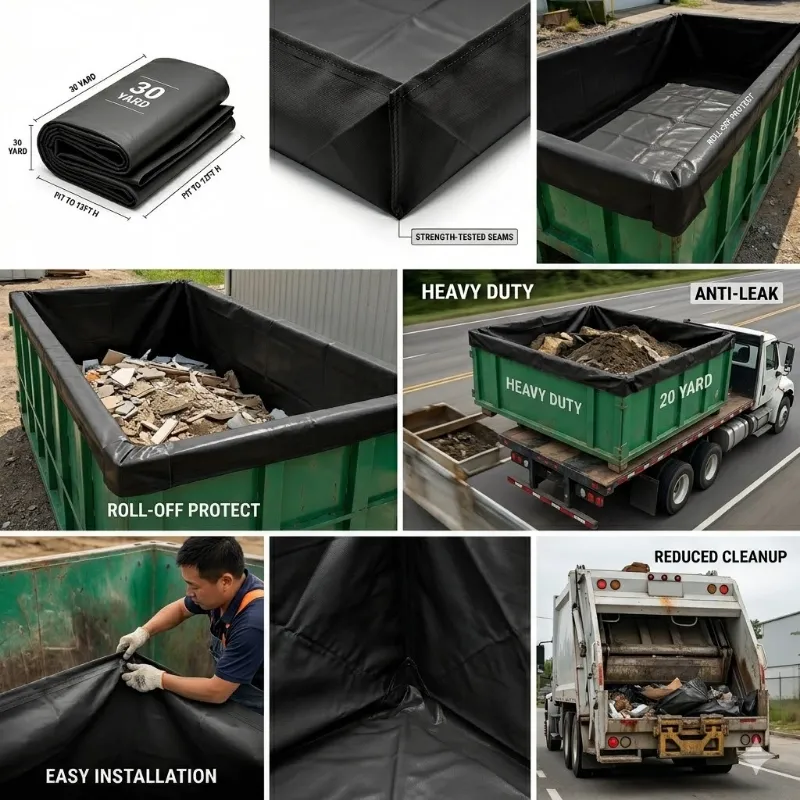
- Reinforced Welded Seams: We moved the seam locations away from the high-pressure floor corners to the sidewalls, significantly reducing the risk of a "blowout."
- Polymer Consistency Control: By using 100% virgin resin and precision extrusion, we ensured that "100 microns" meant 100 microns across every square inch of the fabric.
- Custom Fitment: We matched the liner dimensions exactly to his roll-off specs. A liner that fits like a glove doesn't stretch or stress at the rails.
The Result? The "leaking containers" miraculously fixed themselves. No more fines. No more messy wash-bays. Just clean, compliant transport.
In B2B, the Real Cost is What's Underneath
In this business, problems rarely come from the equipment you can see. They come from the specifications you can't see. If your supplier is just selling you "plastic bags," they aren't solving your problem—they are participating in your risk.
We don't just sell liners. We sell Environmental Security. 👉 Explore our high-integrity containment range:
- Industrial Dumpster Liners: [/dumpster-container-liners]
- De-watering Filtration Liners: [/de-watering-liners]
- Heavy Duty Roll-Off Tarps: [/roll-off-dumpster-tarps]
Is Your Liner Failing Your Container?
If you’re seeing moisture where it shouldn't be, don't rush to repair your steel. Check your liner first. Better yet, let us check it for you. Send us a photo of your most recent "leak," and our engineering team will tell you exactly where the failure is happening.
[Get a Leak-Proof Liner Consultation]
**"Don't pay an environmental fine for a procurement mistake. Match the liner to the load, not just the budget." ** — The TarpManufacture Team