
News Waterproof Tarpsroof tarp
2026年4月3日
Roof Protection Tarps: What Contractors Actually Need (Because a "General Tarp" Is a High-Risk Gamble)
Roof Protection Tarps: What Contractors Actually Need (Because a "General Tarp" Is a High-Risk Gamble)
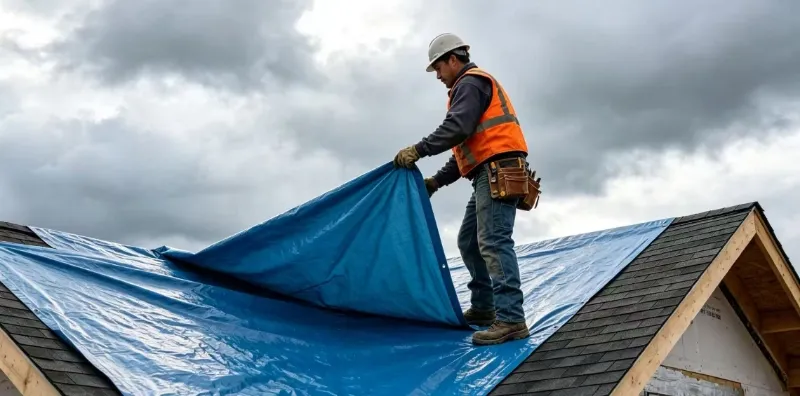
For a roofing contractor, a blue tarp draped over a damaged ridge line isn't just a covering. It's a statement. It's an insurance policy. And most importantly, it’s a temporary contract of trust with a homeowner.
When a storm hits or a project is delayed, the customer's home—their single largest asset—is exposed. They are panicking. Their immediate relief comes from seeing a tarp securely in place. They see the color blue and they assume they are safe.
As a professional contractor, however, you know the truth: A tarp is a temporary measure, and its quality dictates the level of risk you are willing to assume.
At TarpManufacture.com, we interact with hundreds of bulk-buying roofing contractors. The biggest, most dangerous mistake we see is purchasing "general-purpose tarps" for roof protection. In roofing scenarios, "waterproof" is just the ante. What contractors actually need is a system designed to survive a high-altitude, exposed environment.
Here is why specializing your roof tarps matters, and what you must demand from your manufacturer.
The Roof as a High-Risk Environment
The roof is perhaps the most demanding environment for a flexible polyethylene (PE) membrane. It is not like covering a pallet of wood or a pile of industrial raw materials.
On a roof, every standard risk factor is amplified:
1. The Real Threat: Wind Resistance (Not Just Water)
Most contractors focus first on waterproofing. This is a mistake. Every decent PE tarp is initially waterproof. The real battle is not against water ingress; it’s against air moving under the tarp.
A general-purpose tarp has general-purpose grommet strength. If air gets under a 30x50 tarp on an exposed roof, that tarp becomes a 1,500-square-foot sail. The stress on the perimeter grommets increases exponentially. If a single grommet fails, the wind leverages that failure to create more, and the entire tarp can be ripped away in seconds. The water is no longer your problem; the insurance claim for debris damage is.
A general tarp is not designed for wind. A roofing tarp is engineered for wind management.
2. The Danger of "Micro-Shifting" and Abrasion
Even when a tarp seems secure, a general tarp will "micro-shift" in the wind. This constant, subtle movement rubs the woven structure against abrasive roofing materials (asphalt shingles, flashing, metal edges).
General-purpose tarps are thin. They lack the surface density and the abrasion-resistant coating necessary to withstand this constant sanding effect. Within days, a general tarp can develop micro-tears and wear spots, rendering its "waterproof" spec meaningless just when it is needed most.
3. Accelerated UV Degradation
A roof receives the absolute maximum UV exposure possible. A general tarp designed for shaded storage might last three months under intense sunlight. A roof tarp needs robust UV inhibitors integrated into the polymer chain, not just applied as a surface film. UV is an invisible killer of tensile strength. A general tarp will look fine, but by month three, it will become brittle and crack under the slightest tension, again leading to catastrophic failure.
The Fatal Procurement Mistake: Standardizing the "General Tarp"
Bulk buyers and procurement officers love standardization. They like seeing a "General Purpose PE Tarp" SKU that can be used for wrapping machinery, covering tools, and temporary roofing.
This approach fails at the point of application. It’s the classic "jack of all trades, master of none" scenario.
By opting for a general-purpose tarp for roofing scenarios, you are prioritizing a slight reduction in procurement complexity over a massive increase in operational and reputational risk. It only takes one significant tarp failure on a high-value project to erase years of bulk procurement savings.
General tarps are often built with weaker corner reinforcements and lower GSM (grams per square meter) in the core woven scrim. They may meet the specification for initial waterproofing, but they completely fail the test of predictable performance over time in a high-risk environment.
What Roofers Actually Need (A Blueprint for a Professional Tarp)
A specialized roof protection system demands specific, high-performance characteristics. When you, as a B2B contractor, source your tarps, you are not buying specs; you are buying security. Here is what that security looks like:
1. Robust, Multi-Layer Edge and Corner Reinforcement
The number one point of failure is the grommet-to-material bond. A true roofing tarp must have:
- Heat-sealed or double-stitched perimeter hems. A general hem is just folded and glued. A roofing hem needs structural binding.
- Heavy-duty, rust-resistant grommets. Brass or aluminum are not enough. They must be reinforced with a plastic or rubber patch at every eyelet to prevent pull-out under extreme wind tension.
- Reinforced, multi-layer corner guards. The four corners are the highest stress points. They must feature several extra layers of material and possibly reinforced webbing.
2. High-Density, Abrasion-Resistant PE Weave
The density of the weave (the "weave count" and "GSM") determines its physical strength. A roofing tarp should be heavy-duty, usually in the range of 180 to 220 GSM. This provides:
- Higher puncture resistance against sharp flashing edges or nails.
- Greater surface density, which translates to better abrasion resistance.
- Uniform UV inhibitor dosing throughout the entire material, not just the film layers.
3. Integrated Wind Stability (Fast Installation and Security)
Installation time is money. A roof tarp must be designed for fast, secure attachment.
- Integrated Tie-Down D-Rings: D-rings, sewn onto the fabric every few feet, are vastly superior to standard grommets for securing to roof structures with straps or rope. They distribute tension more evenly and are less prone to catastrophic pull-out.
- Optional Perimeter Rope Pocket: This allows a contractor to thread a tensioning rope around the entire tarp, creating a 360-degree secure bond.
- Optional Interwoven Tie-Down Bands: Some advanced tarps incorporate heavy-duty webbing bands woven directly into the PE structure at regular intervals. These serve as built-in anchoring points, dramatically reducing install time.
We Help Match Your Tarp to Your Roofing Scenarios
For bulk buyers of industrial tarps, the question isn't "how cheap is this tarp?" but rather "is this tarp right for the scenario?"
At TarpManufacture.com, we specialize in high-volume, bulk supply of heavy-duty, customized PE tarps. We are not a generalist retailer. We are a manufacture-to-spec consistency partner.
We work with large-scale roofing contracting firms, helping them standardize a specialized Roofing Tarp SKU. We understand that a "bad tarp" for a roof application isn’t just a product failure; it’s an operations failure.
We help you mitigate that risk by providing:
- Manufacturing Consistency: Every batch of our roofing tarps has the exact same UV inhibitor package, same weave density, and same corner reinforcement.
- Scenario-Matching Customization: If your region has high winds, we can design tarps with integrated D-rings. If you face extreme UV, we can adjust the stabilizer package. We build for performance.
- ** bulk Buying Efficiency:** We help procurement teams standardization on a high-value, durable SKU that pays for itself in reduced claims and operational downtime.
Stop gambling with general tarps on your roof protection projects. Partner with a manufacturer that understands the unique pressures your teams face on every job site.
Send us your current usage data and the common scenarios your teams face. We will help you move from a "general tarp" procurement model to a specialized, performance-driven roofing protection system.