
News Lumber ProtectionTarp Problems
2026年4月3日
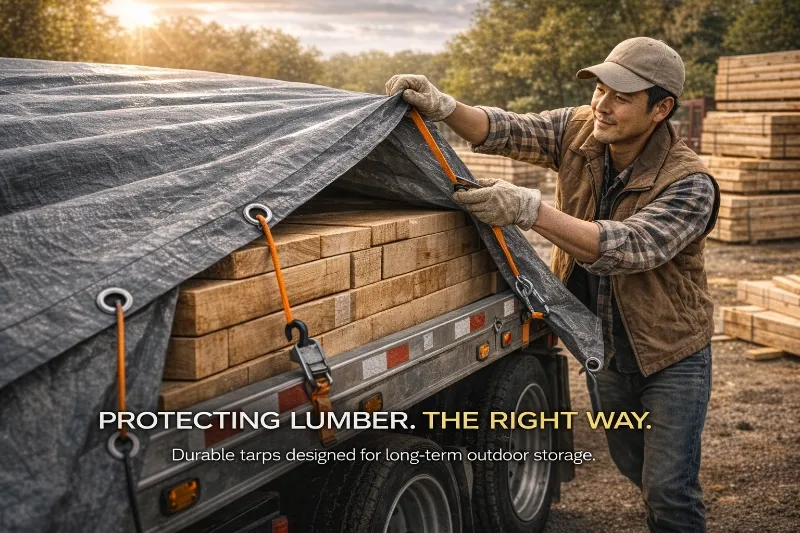
Lumber Protection: Why Standard Tarps Fail (And What Actually Works)
Lumber Protection: Why Standard Tarps Fail (And What Actually Works)
At first glance, lumber doesn’t look like a material that needs special protection.
It’s heavy. Solid. Built for construction.
So many buyers assume:
👉 “Any waterproof tarp should be enough.”
But if you’ve ever handled lumber storage or transport, you already know — that assumption leads to problems.
Because wood doesn’t fail immediately.
It fails slowly.
And by the time damage becomes visible, the value is already lost.
What Actually Happens to Lumber in Storage
Lumber damage is rarely caused by one factor.
It’s usually a combination:
moisture exposure
direct sunlight
uneven coverage
long-term storage
Here’s what we often see:
top layers dry out and crack
bottom layers trap moisture
edges warp due to partial exposure
👉 Same stack. Different conditions. Different results.
That’s the real challenge.
Step 1: Waterproof Is Only the Starting Point
Most buyers begin with one requirement: waterproof.
But for lumber, that’s not enough.
You also need:
UV resistance
consistent coverage
stability over time
Without UV protection:
surface dries too quickly
internal moisture imbalance forms
structural integrity weakens
👉 A tarp can be waterproof and still damage the wood.
Step 2: Coverage Matters More Than Material
This is one of the most overlooked issues.
Most failures are not because of tarp quality —
they’re because of poor coverage.
Common mistakes:
tarp too small
edges left exposed
uneven draping
👉 Even a small exposed area can cause damage over time.
That’s why experienced buyers often choose:
slightly oversized tarps
or custom dimensions
Not for premium positioning —
but to reduce risk.
Step 3: Short-Term vs Long-Term Use
There’s a big difference between:
covering lumber during transport
storing lumber outdoors for weeks
For short-term:
👉 standard tarps are usually fine
For long-term:
👉 you need durability + UV resistance
Otherwise:
replacement frequency increases
customer complaints follow
Real Case
A distributor in Europe was using standard tarps.
Problem:
only outer layers of wood were damaged
customers complained about inconsistent quality
Solution:
switched to UV-treated tarps
increased tarp size slightly
Result:
fewer complaints
better resale value
improved repeat orders
Final Thoughts
Lumber protection is not about “covering.”
👉 It’s about protecting evenly over time.
And small decisions — like size or UV treatment —
make a bigger difference than most buyers expect.
lumber cover tarps → /lumber-cover-tarps
UV resistant tarps → /uv-resistant-heavy-duty-tarps
custom tarps → /custom-heavy-duty-tarps
If you’re dealing with lumber storage or transport,
send us your stack size and exposure conditions.
We’ll help you choose a tarp that protects your material — not just covers it.