
News UV Resistant TarpsTear Resistant Tarps
2026年3月25日
Industrial Use Tarps: What Buyers Should Really Look For
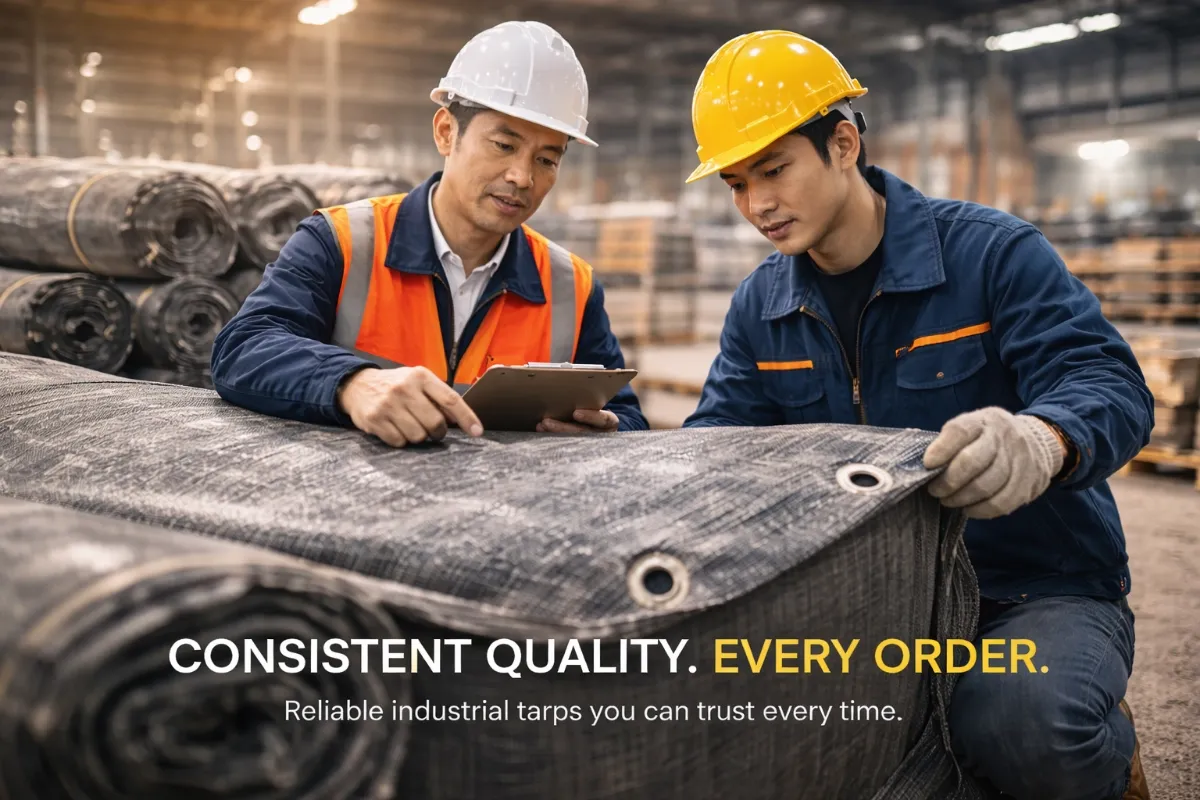
Industrial buyers look at tarps very differently from retail customers. They’re not asking, “Is this tarp strong enough?” They’re asking: 👉 “Will this product perform the same way every time we reo
Industrial buyers look at tarps very differently from retail customers.
They’re not asking,
“Is this tarp strong enough?”
They’re asking:
👉 “Will this product perform the same way every time we reorder?”
Because in industrial use, the biggest risk isn’t a tarp failing once —
it’s inconsistency.
One shipment works fine, the next one causes complaints.
That’s where real problems begin.
What Industrial Buyers Actually Care About
From our experience working with importers and distributors,
industrial buyers usually focus on three things:
- consistency across batches
- reliable strength under repeated use
- predictable performance in real conditions
They’re not looking for the “best looking” product.
They’re looking for something they can trust — every time.
Step 1: Batch Stability Is Often the Real Issue
This is one of the most common problems in bulk sourcing.
On paper, everything looks the same:
- same GSM
- same size
- same material description
But in real use:
- one batch performs well
- another batch tears more easily
- edge finishing varies
- eyelet strength is inconsistent
👉 The spec hasn’t changed — but the experience has.
For distributors, this creates a chain reaction:
- customer complaints
- difficulty explaining differences
- loss of trust
That’s why experienced buyers don’t just check specs —
they check production consistency.
Step 2: Strength Means More Than Just Thickness
Many suppliers focus heavily on GSM.
And while GSM matters, industrial buyers often care more about:
- weaving consistency
- lamination quality
- reinforcement at stress points
A tarp that is slightly lighter but well-constructed
can outperform a thicker tarp with weak finishing.
Especially in industrial environments where tarps are:
- reused frequently
- exposed to friction
- tied under tension
👉 Structure matters as much as material.
Step 3: Standardization Makes Scaling Easier
For industrial buyers, purchasing is rarely a one-time decision.
They need products that can be:
- reordered easily
- applied across different projects
- sold or distributed without variation
This is where standardization becomes critical.
Instead of adjusting specifications every time,
many buyers prefer:
👉 stable, repeatable product lines
This reduces:
- communication cost
- risk of mismatch
- after-sales issues
A Practical Example
We’ve seen distributors who initially focused only on price.
They sourced from multiple suppliers to reduce cost,
but ended up facing:
- inconsistent quality
- difficulty managing inventory
- frequent customer feedback issues
Later, they switched to a more standardized sourcing approach.
Even though the unit price was slightly higher:
- complaints dropped
- operations became smoother
- repeat orders increased
👉 In the long run, consistency proved more valuable than price alone.
Final Thoughts
Industrial tarps are not about finding the cheapest option
or even the “strongest” one.
They’re about finding a product that performs predictably.
Because in industrial supply,
👉 reliability is what keeps customers coming back.
If a product behaves the same way every time,
it becomes easier to sell, easier to manage, and easier to scale.
If you’re sourcing tarps for industrial use,
tell us your application and order frequency.
We can help you build a more standardized and reliable product solution —
so you don’t have to deal with inconsistency issues later.