
News Container LinerDumpster Container LinerWaterproof Tarps
2026年4月3日
Dumpster Container Liners: How to Reduce Cleanup Costs in Real Operations
Dumpster Container Liners: How to Reduce Cleanup Costs in Real Operations
In the waste management and industrial hauling business, the "silent killer" of your profit margin isn't fuel prices or equipment maintenance. It’s cleanup time.
If you are operating a fleet of roll-off containers or dumpsters without high-quality liners, you are essentially paying your crew to do the most inefficient job in the world: scraping dried sludge, power-washing rusted steel, and deodorizing containers that should already be back on the road.
work with industrial waste contractors who have realized that a dumpster is more than just a steel box—it’s an asset that only makes money when it’s moving.
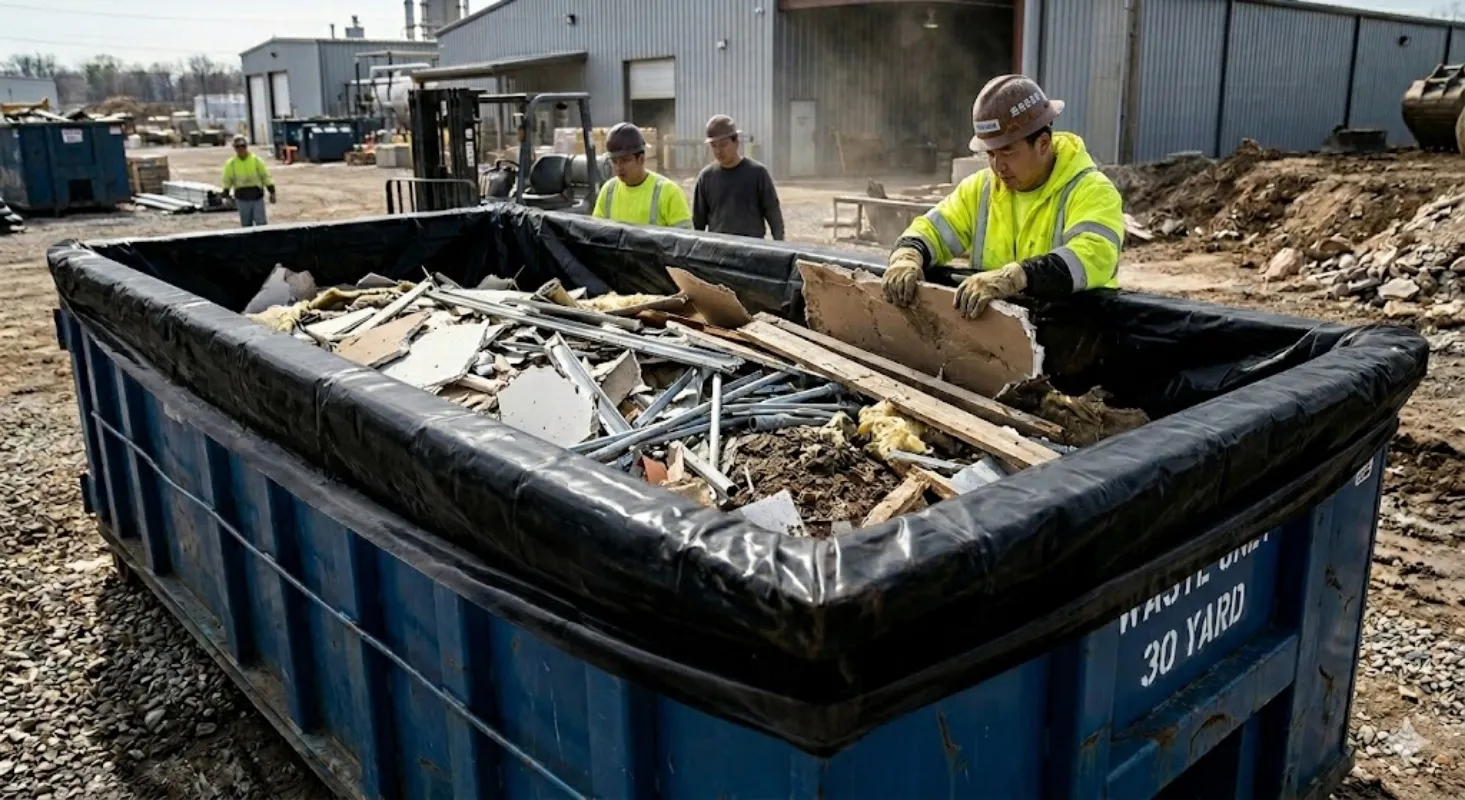
Here is how high-performance polyethylene (PE) container liners transform your bottom line by attacking the three core problems of waste logistics: leakage, cleaning costs, and operational inefficiency.
The Core Problem: The Hidden Cost of the "Empty" Dumpster
When a driver drops off a load at the landfill or recycling center, the container is rarely truly "empty."
- The Leakage Nightmare
If you are hauling wet waste, sludge, or construction debris containing liquids, the seals on your tailgate are under immense hydraulic pressure. A single pinhole leak transforms your truck into a mobile environmental hazard. Fines for "liquid tracking" on public roads can exceed the entire profit of the haul.
- The Cleaning Cost Trap
Without a liner, materials like wet concrete, organic waste, or industrial adhesives bond to the steel floor and corners.
Labor: You pay workers to manually scrape the container.
Water & Chemicals: Power washing consumes thousands of gallons of water and expensive degreasers.
Corrosion: Constant washing accelerates rust, shortening the lifespan of your 8,000 containers.
- Systematic Inefficiency
Every minute a container spends in the wash bay is a minute it isn't at a job site earning a tipping fee. In a high-volume operation, "wash time" can reduce your fleet's total capacity by 15% to 20%.
Step 1: Why "Fit" Is the First Line of Defense
Most procurement managers treat liners as a commodity, buying based on the lowest price per unit. However, fit matters more than price.
If a liner is too small, it will stretch and tear the moment the first heavy load hits the floor. If it’s too large, excess material bunches up, creating "pockets" where liquids can pool or getting caught in the tailgate seal, actually causing a leak rather than preventing one.
A Professional Fit Means:
- Gusseted Bottoms: Liners designed to match the rectangular geometry of a standard 20-yard or 40-yard roll-off.
- Over-the-Rail Security: Enough material to drape over the top edges so the liner stays in place during high-impact loading.
- Consistent Micron Thickness: Cheap liners have "thin spots" from poor manufacturing. A TarpManufacture liner maintains uniform strength across the entire surface.
Pro Tip: Don't guess. Send us your container dimensions (Length x Width x Height), and we will match the liner to your specific fleet.
Step 2: Balancing Strength vs. Cost (The Cheap Tarp Paradox)
There is a common misconception that "the thicker the liner, the better." This isn't always true. If you buy a 10-mil liner for light cardboard waste, you are overpaying. If you buy a 3-mil liner for jagged demolition debris, you are wasting money on a product that will fail instantly.
How to Choose Your Strength:
- Light Duty (3–4 mil): Best for household cleanouts, municipal waste, and dry recyclables.
- Medium Duty (6–8 mil): The "sweet spot" for general construction debris and semi-wet industrial waste.
- Heavy Duty (10 mil+): Essential for sludge, hazardous materials, or debris with sharp metal edges.
our polyethylene liners are engineered with High-Drip-Point resins. This means they have superior puncture resistance compared to standard "hardware store" plastic sheeting. By using advanced co-extrusion technology, we can offer a 6-mil liner that outperforms a competitor's 8-mil liner, saving you money on shipping and material costs without sacrificing security.
Real Case Study: From Wash Bay to Way Ahead
The Client: A regional waste hauler in the Midwest with a fleet of 50 roll-off containers.
The Problem: They were spending an average of 45 minutes per container on cleaning after hauling food processing waste. Their annual labor cost for "cleaning" alone exceeded $40,000, not including water and container downtime.
The Solution:We transitioned them to a custom-fit 6-mil PE liner specifically sized for their 30-yard containers.
The Result:
Cleanup Time: Dropped from 45 minutes to 5 minutes (just a quick rinse to ensure no residue on the rails).
Labor Savings: They were able to reassign two "wash bay" employees to more productive maintenance roles.
Container Life: Reduced rust spots meant they deferred their container repainting schedule by 18 months.
The "Dump" Advantage: The waste slid out of the container effortlessly (the "non-stick" property of PE), reducing the risk of "tip-overs" caused by stuck loads.
Final :Protect Your Equipment, Not Just Your Load
An industrial dumpster is a heavy-duty tool, but it is not indestructible. Using a high-quality polyethylene liner is an investment in your equipment's longevity and your crew's efficiency.
If you are tired of paying for labor that doesn't generate revenue, it's time to stop washing and start lining.
Explore Our Specialized Solutions:
Custom Sized Dumpster Liners: Click here to see dimensions →
UV-Resistant Outdoor Covers: /uv-resistant-heavy-duty-tarps
Custom Heavy-Duty Tarps for Hauling: /custom-heavy-duty-tarps
Ready to Optimize Your Cleanup?
Don't let leakage and cleaning costs erode your margins. Send us your container size and the type of waste you handle most. Our engineering team will recommend a liner thickness and fit that protects your material—and your bottom line.